


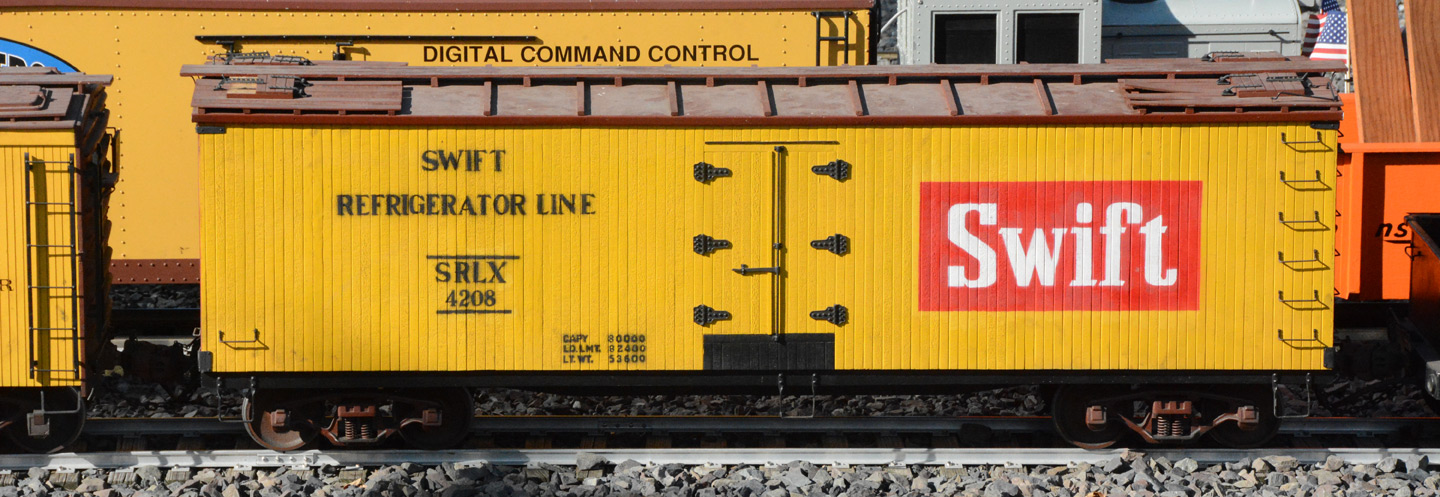
Rules for the Operation of Cars and Trains 2½-Inch Gauge and Larger
- It is recommended that all riding cars have effective brakes.
- All trains must be able to demonstrate the ability to stop safely.
- Either Couplers and safety chains, or drawbars, must be used between locomotives and all cars of a train. All safety chains must have welded links and have a minimum stock diameter of 0.110-inch. Trains operated on the multi-gauge loop may use smaller, appropriately sized chain.
- The attaching points for safety chains must be firmly mounted to the structure of each car and locomotive.
- All trains with passengers occupying more than two cars or with more than six total passengers must have a conductor on the last riding car to enforce passenger and train safety. Any such train must have 2-way radio communication between engineer and conductor.
- No car will exceed a load of one adult per axle.
- Loading of trains will be done at the stations, unless otherwise directed by the engineer / conductor.
- All cars are to be constructed in a safe and sturdy manner. Cars must be free of sharp edges and pinch points.
- It is recommended that all riding cars have seats.
- All cars coupled together must maintain 75% vertical engagement of the couplers.
- Rocking of cars should be kept to a minimum.
- Seats on cars that are not attached to the car cannot be higher than the front to back length of the seat. Seats must be restrained from sliding off.
- Seat height on freight type riding cars is to be a maximum of 18 inches from the railhead for 7¼-inch gauge. Smaller gauges should adjust seat height appropriately.
- Passenger-carrying seats must not turn or rotate.
- PLS reserves the right to declare a car or train unsafe for service and prohibit its use.
Approved by the PLS Membership August 21, 2004